


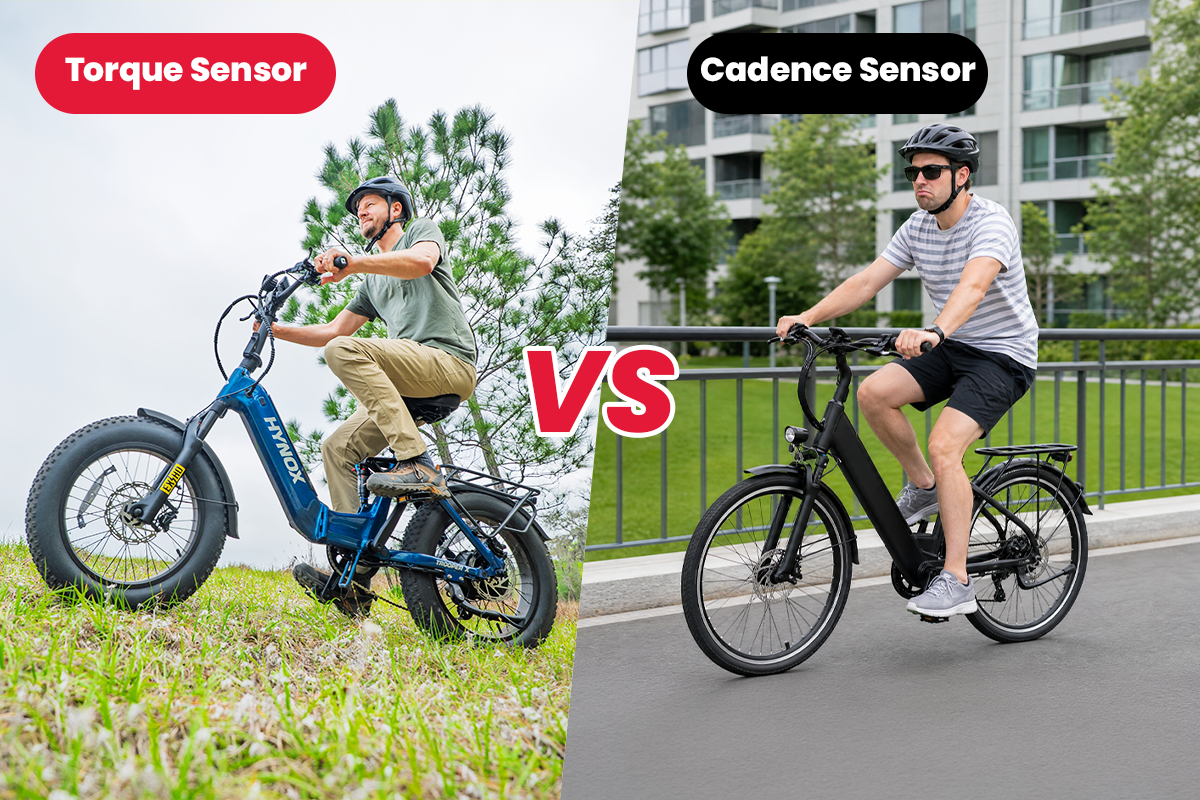
Most first-time ebike buyers obsess over battery size or motor wattage. But if you want to know how an ebike will actually feel when you ride it, you need to look at a small, often overlooked component hidden near the pedals: the pedal assist sensor.
Two ebikes with identical motors and batteries can feel completely different to ride. One might feel like a wild stallion jerking forward unexpectedly, while the other feels like an organic extension of your own body.
The secret lies in whether the bike uses a Torque Sensor or a Cadence Sensor to feed input to its Pedal Assist System (PAS). In this guide, we’ll break down exactly how each system works, the pros and cons, and help you decide which one belongs on your next ride.
What is a Torque Sensor? (The Strength Multiplier)
A torque sensor is a more advanced piece of technology favored by premium ebike brands (including all models in the Hynox lineup).
How it works: If a cadence sensor is a simple switch, a torque sensor is a precision scale. It uses a strain gauge to measure exactly how much physical force you are applying to the pedals in real-time. It communicates with the motor thousands of times per second.
The Ride Feel: The motor dynamically matches your effort. If you pedal gently on a flat road, the motor gives you a gentle push. If you stand up and mash the pedals to conquer a steep hill, the motor instantly unleashes maximum power. You feel like you suddenly grew bionic legs.
Pros of Torque Sensors:
- Instant Power (Zero Lag): Because it measures pressure, the motor engages the microsecond you put weight on the pedal. There is no waiting for the pedal to turn, making hill starts a breeze.
- Natural Riding Experience: It feels exactly like riding a traditional bicycle, just significantly easier. You are always in complete control of the bike’s speed through your own leg input.
- Maximized Battery Range: The system constantly optimizes power consumption. On flat roads where you pedal lightly, the motor draws minimal current; when you push harder on climbs, it scales up instantly. This intelligent, real-time power modulation extends your range significantly compared to a traditional cadence setup.
- Effortless Cruising: Think a torque sensor means you have to sweat? Not at all. Premium torque-sensor eBikes come equipped with a throttle. When you want a zero-effort commute, you simply use the throttle—making a cadence sensor's clunky "ghost pedaling" completely obsolete.
Cons of Torque Sensors:
- Higher Initial Cost: The precision engineering makes the bikes slightly more of an investment upfront.
What is a Cadence Sensor? (The Rotation Monitor)
A cadence sensor is the most common and basic type of pedal assist technology, often found on entry-level ebikes.
How it works: Think of a cadence sensor as a pedaling speed tracker. It measures the rotation of your pedals (RPM) rather than how hard you're pushing. It usually consists of a magnetic disc installed on the bike's bottom bracket. When you start pedaling, the sensor detects movement (Yes, the pedals are turning). Once movement is detected, it signals the motor to deliver a flat, predetermined amount of power based on the assist level you selected on your display (e.g., Level 1, 2, or 3).
The Ride Feel: It doesn't care how hard you are pushing, only that your legs are moving. You could be lightly spinning the pedals without putting any actual effort into moving the bike, and the motor will still push you along at top speed. This is often referred to as "ghost pedaling."
Pros of Cadence Sensors:
- Cost-Effective: Because the technology is simpler, ebikes with cadence sensors are generally more affordable.
Cons of Cadence Sensors:
- An Unnatural, Clunky Ride: Instead of responding to your leg force, the motor simply injects power after a delay. This lag-and-surge effect can make starts on steep hills tricky and the overall ride feel unrefined.
- Less Battery Efficient: Because the motor outputs a flat rate of power regardless of your effort, it tends to drain the battery faster.
The Head to Head Showdown
| Feature | Torque Sensor | Cadence Sensor |
| How it measures | Pedal force (Downward pressure) | Pedal movement (RPM) |
| Power Output | Dynamic, proportional to effort | Flat, predetermined |
| Responsiveness | Instantaneous | Delayed (Lag before engaging) |
| Ride Feel | Natural, like having super-legs | Like a scooter with pedals |
| Battery Efficiency | Higher | Lower |
| Best For | Enthusiasts, hills, natural ride feel | Budget buyers |
The Verdict: Which Sensor Wins?
Ultimately, the choice comes down to what you value most on the road.
While cadence sensors still hold a niche for ultra-budget builds, the market is increasingly shifting toward torque sensors. With a thumb throttle already handling effortless, no-pedal cruising, riders are looking for a more natural, responsive cycling experience when they actually do pedal.
Because torque sensors deliver that seamless, bionic feel—and require much more advanced engineering—they naturally command a higher price tag. That’s exactly why you’ll find countless online guides dedicated to upgrading older cadence setups into torque systems. Torque is, without a doubt, the superior riding experience.
The Hynox Perspective: Why Torque Alone Isn't Enough
While choosing a torque sensor over a cadence sensor is a massive upgrade, it's only part of the equation for a truly exceptional ride.
Many riders buy a torque-sensor ebike, only to find it still struggles on steep inclines. Why? Because a sensitive sensor is useless if the motor doesn't have the muscle to back it up.
At Hynox Bikes, we build our rides around a complete, intelligent powertrain: Precision Sensing (The Nerves), Smart Processing (The Brain), and High-Torque Power (The Muscle).
- The Nerves (Torque Sensor): Feels your exact pedaling effort in real-time, detecting your riding intent without delay.
- The Brain (Smart Controller): Processes thousands of sensor signals per second to instantly determine how much power you need.
- The Muscle (High-Torque Motor): Delivers massive pushing power the exact millisecond the brain gives the command.
| Component | Torque Sensor | Smart Controller | High-Torque Motor |
| Role | The Nerves (Sensing) | The Brain (Processing) | The Muscle (Execution) |
| Core Function | Detects pedaling force & rider intent | Calculates ideal power output in real-time | Provides raw pushing power & torque |
| Ride Impact | Instant, lag-free responsiveness | Smooth, natural power modulation | Unstoppable hill climbing & acceleration |
When facing a steep 20% grade hill, a bike shouldn't just know you need help—it needs the raw muscle to launch you to the top effortlessly.
That exact engineering philosophy drives the Hynox lineup. Unlike many brands that simply slap together off-the-shelf, generic controllers with jerky power delivery, we design and custom-tune our proprietary controllers in-house. This ensures our advanced torque sensors and high-output motors communicate in perfect harmony.
Here is how our custom-tuned powertrain translates to the road:
- Hynox Trooper X: The ultimate powerhouse, delivering a staggering 1600W peak power and 100 Nm of torque for the most extreme, uncompromising terrains.
- Hynox Trooper: Offering incredibly smooth and robust energy, pushing 1400W peak power and 85 Nm of torque to conquer everyday hills with absolute ease.
- Hynox Flex: Our versatile daily driver that punches way above its weight class, featuring 1300W peak power and 75 Nm of torque.
Share:
What to Know Before Buying an eBike: A Beginner's Buying Guide
Choose Your HYNOX